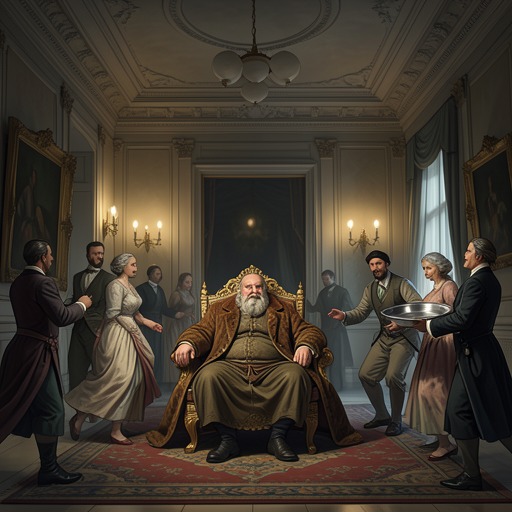
Anna Pavlovna Scherer
War and PeaceAnna Pavlovna Scherer is a prominent Petersburg society hostess, maid of honor, and favorite of Empress Marya Fedorovna. Her drawing room is one of the novel’s first decisive social spaces: a polished stage on which war, loyalty, rank, fashion, and national destiny are performed as conversation. Her importance lies less in private biography than in her mastery of this stage. She converts hospitality into social government, arranging people, topics, and gestures so that the machinery of aristocratic life continues to run even when the historical world outside it is moving toward war.
Identity and Social Position
Anna Pavlovna first appears in July 1805, suffering from what she calls la grippe, a fashionable new word in Saint Petersburg used by the elite. Her invitations, written in French and delivered by a scarlet-liveried footman, present illness as both a social inconvenience and an attractive reason for gathering. She greets Prince Vasili Kuragin with mock alarm over the political transformation produced by Napoleon Bonaparte, warning that she will no longer regard him as a friend if he refuses to call the situation war. The greeting immediately establishes her characteristic mixture of theatrical indignation, political conviction, and social intimacy.
Her rank gives her access to the highest circles, but her authority depends on performance rather than formal office. The narrative describes her as animated and impulsive despite her forty years, with enthusiasm functioning as her social vocation. Even when she does not genuinely feel enthusiastic, she becomes enthusiastic so as not to disappoint the expectations of those around her. Her habitual smile expresses a continuing awareness of her own charming defect, and this self-consciousness becomes part of her persona: she knows that society expects animation from her and supplies it on cue.
The Reception as Social Machine
Anna Pavlovna’s reception gathers the highest Petersburg society, including Helene Kuragina, Hippolyte Kuragin, the young Princess Lise Bolkonskaya, the Abbe Morio, and other figures connected by rank rather than intimacy. Her method is visible in her treatment of the little old aunt whom no guest knows or wishes to know. Each arrival is gravely conducted to the aunt, performs the required greeting, and departs with relief. Anna Pavlovna watches these exchanges with solemn approval, enforcing a ritual whose meaning lies precisely in its lack of personal feeling.
She manages the room as though it were a mechanical apparatus. Moving among groups, she approaches a conversation that has fallen silent or become too noisy and restores its proper rhythm by a word or slight rearrangement. The comparison to a foreman regulating the spindles of a spinning mill captures her social function: she does not merely participate in conversation but monitors its flow, correcting irregularities before they disturb the whole. Her drawing room depends on continuous maintenance, and her attentiveness reveals that aristocratic ease is laboriously produced.
Pierre Bezukhov exposes the limits of this system. As a large, recently returned young man making his first appearance in Russian society, he is observant, natural, shy, and unsure of the room’s rules. Anna Pavlovna gives him the lowest-grade greeting and watches him with anxiety, sensing that his presence is too unconstrained for the carefully calibrated setting. Pierre turns away before her aunt has finished speaking, then continues explaining why the Abbe Morio’s plan for perpetual peace is impractical even after Anna Pavlovna attempts to withdraw. She finally smiles and says, "We will talk of it later," while hastening to resume control of the room. His awkwardness is not simply comic; it shows that the salon’s apparent spontaneity depends on obedience to invisible conventions.
Political Language and Historical Change
Anna Pavlovna’s political speech is fervently pro-Russian and monarchist. She distrusts Austria, insists that Russia alone must save Europe, and presents Emperor Alexander I as a virtuous sovereign whose noble vocation will be protected by God. She describes Napoleon as a murderer, villain, and Antichrist, and casts European diplomacy as a moral drama in which England’s commercial spirit, Prussia’s neutrality, and Austria’s supposed betrayal all reveal failures of understanding or loyalty.
Her language turns policy into providential theater. Russia’s foreign action is represented as self-abnegation undertaken for the good of mankind, while opposition becomes evidence of corruption or spiritual blindness. Prince Vasili’s languid references to decisions and dispatches contrast with her animated certainty, yet both belong to the same social world: his indifference and her enthusiasm are different performances within the same elite conversation. She supplies the moral heat that makes court politics feel like a crusade, while he supplies the bored confidence of inherited position.
The novel later places Anna Pavlovna’s salon beside Helene Kuragina’s as examples of Petersburg life in which form prevails over substance. Years pass; peace is made, quarrels resume, constitutions are made and unmade, and Napoleon’s power transforms Europe, but Anna Pavlovna’s salon remains essentially unchanged. Its members continue to discuss Napoleon’s successes as though they were the result of a malicious conspiracy directed against the court circle she represents. This recurrence makes her less a changing individual than an emblem of institutional continuity: history alters the vocabulary of society without necessarily altering its habits of perception.
Relations, Hosting, and Influence
Anna Pavlovna’s relationship with Prince Vasili Kuragin is intimate in form but guarded in substance. She calls him a friend and invokes the language of a "faithful slave," yet their exchange is also a contest of political expectations and social control. He answers her accusations with calm patronage, while she attempts to draw him into the emotional register of the crisis. Their conversation demonstrates how aristocratic familiarity permits irony, hierarchy, and manipulation to coexist beneath polished courtesy.
Her connection with Pierre Bezukhov is more revealing because he does not yet possess the habits that make the salon function smoothly. She recognizes his intelligence but fears his lack of tact, naturalness, and willingness to follow a prescribed route through the room. Later, after Pierre’s inheritance changes his standing, her attitude changes with society’s. Remarks that once seemed tactless or foolish now appear charming; a pink invitation even emphasizes that Helene Kuragina will be present, making explicit the new social link others perceive between them. Anna Pavlovna’s revised treatment shows that her judgments are responsive to rank and reputation as much as to personality.
Her reception also includes the social presentation of family and gendered identity. Princess Lise Bolkonskaya, pregnant and not attending large gatherings, is nevertheless welcomed as a figure whose beauty and vitality animate the room. Anna Pavlovna’s salon makes such appearances legible: the pregnant princess, the maid of honor in a ball dress, the aristocratic sons and daughters, and the ceremonially greeted aunt each occupy a recognized position in the social tableau.
Narrative Role and Significance
Anna Pavlovna is the novel’s first great organizer of appearances. She introduces the reader to a society that speaks in the language of European politics while remaining governed by etiquette, hierarchy, and self-preservation. Her salon connects private manners to public history: declarations of war, imperial virtue, diplomatic betrayal, and social ambition all pass through the same conversational machinery.
Her repeated presence also supplies a structural contrast between motion and stasis. Armies march, sovereigns meet, friendships alter, and Napoleon’s fortunes rise, yet the salon renews its familiar poses. Anna Pavlovna’s enthusiasm therefore has an ironic double meaning. It is sincere as a social habit and powerful as a form of collective belief, but it can also preserve old interpretations after events have made them inadequate. She is not merely a hypocritical hostess; she is the skilled custodian of a world whose rituals create belonging while filtering out whatever cannot be made to fit them.
Through Anna Pavlovna, the narrative shows that social order is neither effortless nor neutral. It requires constant correction, ceremonial repetition, controlled language, and the conversion of personal feeling into acceptable public form. Her drawing room is consequently both a setting and a model of aristocratic society: elegant, animated, anxious about disorder, and determined to keep the conversational machine moving while history gathers force beyond its doors.